For many landlords in Uganda, collecting rent is not the only challenge.
Electricity can become another source of administrative work.
A landlord may receive a utility bill for an entire property, calculate individual tenant consumption, follow up on unpaid electricity charges and resolve disagreements when tenants believe they are being overcharged.
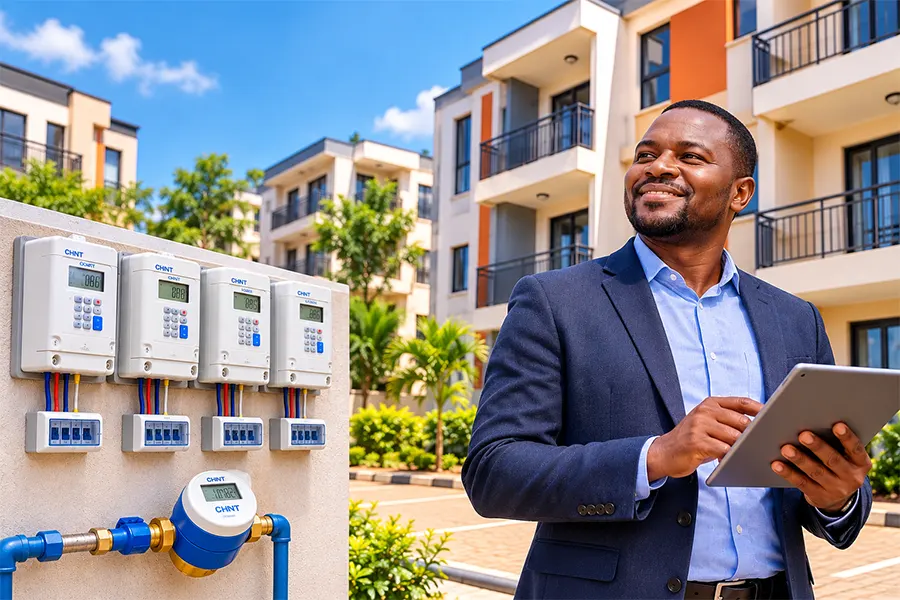
This is where prepaid electricity metering for rental properties can provide a better way to manage consumption and payments.
The Electricity Challenge for Rental Properties
Consider a property with 20 rental units.
If all tenants depend on one electricity bill, the landlord or property manager may have to determine how the total electricity cost should be distributed.
Now imagine one tenant operates several refrigerators, another runs a salon and another occupies a small one-bedroom unit.
Their electricity consumption will naturally be different.
A flat electricity charge may therefore be unfair, while manually calculating individual consumption can become time-consuming.
With individual prepaid meters, each unit can have its own measured consumption.
How Does Prepaid Metering Work for Landlords?
The concept is straightforward.
A property’s electrical system can be designed with individual meters for the respective rental units.
The tenant then purchases electricity credit and uses electricity according to that available balance.
Five Benefits of Prepaid Meters for Landlords
1. Reduce Electricity Payment Problems
One of the biggest benefits is payment control.
The landlord does not necessarily have to wait until the end of the month to recover electricity costs from tenants.
The tenant purchases electricity credit before consumption.
This can help reduce accumulated electricity arrears.
2. Reduce Billing Disputes
Electricity disputes often occur when tenants do not understand how their share of a common bill was calculated.
Individual metering creates a clearer measurement point for each unit.
Instead of asking:
“Why is my electricity bill this high?”
the tenant can monitor their own electricity consumption and available credit.
3. Encourage Responsible Consumption
When tenants can see their electricity balance and usage, they may become more conscious of how much electricity they consume.
This can encourage better energy management.
4. Simplify Property Management
A landlord managing dozens of rental units needs systems that reduce repetitive administrative tasks.
Automated or organized prepaid metering can reduce manual electricity calculations and collection activities.
5. Improve Transparency
A good metering system creates clearer information for both parties.
The landlord can manage the property more effectively while the tenant has greater visibility into their own electricity consumption.
Are Prepaid Meters Suitable for Apartments?
Yes.
Apartment developments are particularly suitable for individual metering because every unit can have its own electricity consumption profile.
A developer constructing a 50-unit apartment building, for example, can plan the electrical distribution and metering arrangement from the beginning.
For existing buildings, a technical assessment should first be carried out to determine how individual meters can be incorporated into the existing electrical system.
What About Water?
The same principle can be applied to water.
A property with multiple tenants can use individual water meters or prepaid water metering solutions to improve consumption visibility and accountability.
This is particularly relevant where landlords are dealing with:
- High water consumption
- Water wastage
- Shared water bills
- Tenant disputes
- Difficulty recovering water charges
Electricity and water metering can therefore form part of a broader property utility-management strateg
Leave a Reply